
What makes a real estate project successful? Is capital enough to realize a good real estate investment? And how do you, as an entrepreneur, handle risks and uncertainty when decisions made today only show their full impact years later?
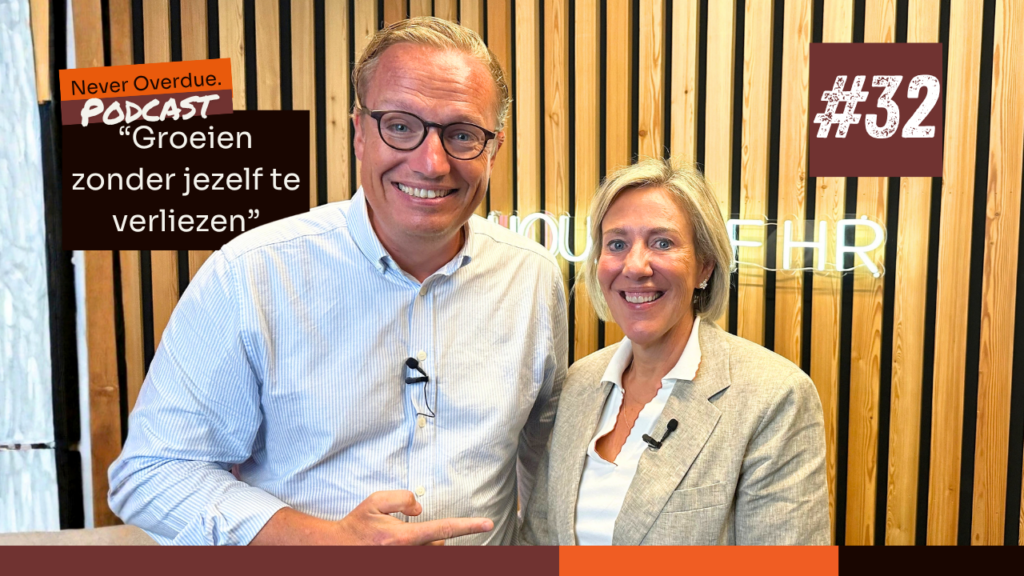
In the latest episode of the Never Overdue Podcast, Jean-Paul Van Damme engages in a conversation with Frederic Van der Planken, founder and CEO of Whitewood. The discussion focuses on real estate development, but the insights reach much further. Frederic speaks about expertise, risk management, long-term vision, stakeholder management, and entrepreneurship.
For those active in real estate, finance, entrepreneurship, or project development, the conversation offers an interesting perspective on how to approach complex projects and uncertain market conditions.
Why is capital alone not enough for successful real estate development?
According to Frederic Van der Planken, a real estate project is not just about the availability of capital. Real estate development is a specialized craft in which knowledge of construction costs, returns, regulations, market conditions, and risks is essential.
A miscalculation of any one of these factors can have major financial consequences. Van der Planken cites the example of a competitor who paid millions of euros more for a project because construction costs were incorrectly estimated.
For Whitewood, this confirms a fundamental principle: expertise and experience are crucial in real estate development. Assessing a real estate project based on superficial comparisons or the purchase price alone can lead to poor investment decisions.
“Capital often forgets that our profession is a craft.”

How do you, as a real estate entrepreneur, handle uncertainty and risk?
Experience does not mean you can predict all risks or unexpected events. According to Frederic Van der Planken, uncertainty is a structural part of entrepreneurship and real estate development.
Market conditions can change, geopolitical events can influence projects, and circumstances can shift unexpectedly during development. Therefore, the goal is not to exclude every risk in advance, but for an organization to be able to respond quickly and effectively when the situation changes.
Whitewood therefore works with multidisciplinary expertise. By bringing different areas of expertise together, the company can react more quickly when unexpected problems arise.
According to Van der Planken, experience does not provide certainty. It ensures that an organization is better prepared for uncertainty.
“The only thing you can be certain of is that you cannot prepare for everything in advance.”
Why are collaboration and stakeholder management important in real estate projects?
Large-scale real estate projects have an impact that goes far beyond the building itself. They often influence neighborhoods, cities, and communities for decades.
That is why Frederic Van der Planken does not see various stakeholders as opponents, but as parties who can work together to find a better solution. Complex real estate development involves developers, governments, and other public and private partners.
An example of this is the redevelopment of parts of the European Quarter in Brussels. Whitewood brought various stakeholders together early on to develop a shared vision.
This approach makes it possible to look beyond the interests of a single party and toward a solution with sufficient support from all those involved.
“We are not enemies. We can perfectly sit alongside one another to create better solutions.”
What can entrepreneurs learn from real estate development?
Although many examples in the conversation come from the real estate sector, the principles are also relevant to other entrepreneurs.
A first lesson is that expertise is more important than financial strength alone. A second is that risks do not completely disappear with experience. Good entrepreneurs build organizations that can respond when circumstances change.
A third lesson concerns collaboration. Complex challenges are rarely solved by one party alone. By bringing the right people and stakeholders together early, better decisions can be made.
In many ways, this makes real estate development comparable to other forms of entrepreneurship: you must look ahead, understand risks, and at the same time remain flexible enough to adjust along the way.

What is Frederic Van der Planken’s most important entrepreneurial lesson?
The common thread throughout the conversation with Frederic Van der Planken is that you cannot predict everything, but you can prepare for the unexpected.
For real estate developers, this means investing in expertise, multidisciplinary teams, and good relationships with stakeholders. For entrepreneurs in general, it means looking not only at the scenario you expect today, but also at your ability to react when that scenario changes.
Successful entrepreneurship is therefore not just about making the right decision today. It is also about creating an organization that can make the right decision again tomorrow.
Conclusion: real estate development requires expertise, vision, and resilience
The conversation with Frederic Van der Planken makes it clear that successful real estate development requires much more than capital. Expertise, risk management, collaboration, and a long-term vision play at least as important a role.
The same principles apply to entrepreneurship in a broader sense. Uncertainty is inevitable. The challenge is not to predict or exclude every risk, but to ensure your organization is strong enough to handle it.
Whether it concerns real estate development in Brussels, a complex investment, or the growth of a company: you cannot predict everything, but you can prepare yourself to respond better.
Frequently Asked Questions about Frederic Van der Planken and Whitewood
Frederic Van der Planken is the founder and CEO of Whitewood. In the Never Overdue Podcast, he speaks about real estate development, entrepreneurship, risk, leadership, and collaboration with public and private stakeholders.
Whitewood is active in real estate development. The company works on complex real estate projects where expertise, project development, investments, and collaboration with various stakeholders come together.
According to Frederic Van der Planken, real estate development is a specialized craft. Knowledge of construction costs, returns, market conditions, and project risks is necessary to make sound investment and development decisions.
Uncertainty cannot be completely excluded. However, organizations can prepare for it better by building expertise, assembling multidisciplinary teams, and ensuring they can react quickly when circumstances change.
Large-scale real estate projects have consequences for various public and private stakeholders. By bringing these parties together early and seeking a shared solution, greater support can be generated and complex projects can be better addressed.