
The automotive sector in Belgium and Europe is in a state of flux. With the rise of electric vehicles (EVs), changing tax deductibility rules, increasing fleet ages, and a shrinking total market (from 550,000 to 420,000 new vehicles sold per year), car dealers are facing challenging times. How do you build an independent automotive group from scratch to more than €200 million in turnover in such a dynamic retail market?
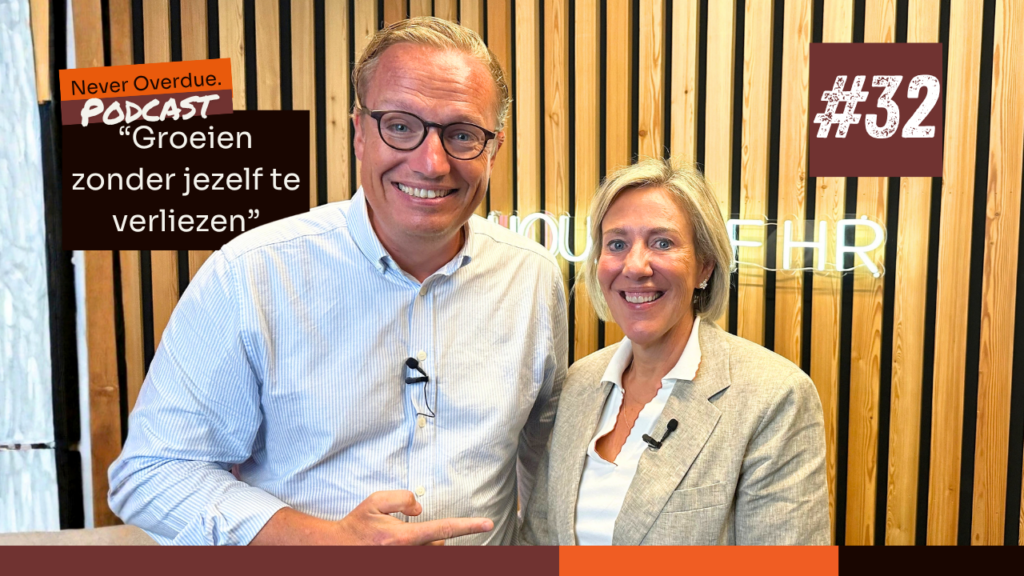
Never Overdue. Ep. 30: In this episode of the Never Overdue Podcast, Jean-Paul Van Damme talks with Hadelin d’Hoop, founder and CEO of ACB Group.
How does the relationship with banks and working capital influence the growth rate of a car dealer?
According to Hadelin d’Hoop, a rock-solid business plan with a demonstrable track record is the absolute foundation: no banker will invest in a weak plan. But in automotive retail, the actual growth rate is primarily determined by the banks and the available working capital.
ACB started in 2010 when Hadelin used the WCO legislation (Continuity of Enterprises Act) to rescue assets from the bankrupt Dutch holding company. In addition to a startup banker for the base capital, a second bank was crucial for working capital, which was established partly thanks to the Flemish guarantee scheme for bank credits.
In the automotive sector, dealers must pay the manufacturer/importer for new vehicles within 5 to 21 days. Since the money from the customer, leasing company, or bank only arrives upon actual delivery, tight short-term credit lines for inventory financing and fast inventory turnover are vital for scaling.

What is more decisive for a car dealer’s success: the car brand or the dealer’s operational management?
Hadelin considers this a 50/50 interaction. When a car brand misses the mark in terms of model range, pricing, or technology, even the best concessionaire in the world cannot be successful. The success of ACB is therefore inextricably linked to the strong performance that brands like Volvo and Toyota have delivered over the past decade.
On the other hand, automotive retail is a business with razor-thin margins (the target is an average of 2% net profit on turnover). Because a huge amount of money changes hands but very little remains at the bottom line, the principle “Retail is Detail” applies. Every detail in cost control, personnel management, customer service, and inventory management makes the difference between profit or loss. The human factor and the drive of the entrepreneur and his team ultimately make the dealer profitable.
Why do some car dealers choose expansion and consolidation during economic crises?
Crises (such as post-COVID market disruptions, rising costs, and delayed deliveries due to geopolitical conflicts) lead to accelerated market consolidation. Many traditional concessionaires become fatigued by the increasing pressure and prefer to sell the company or exit, which offers acquisition opportunities to growing holdings.
Hadelin compares his way of doing business to his passion for motorsport: “Pied au plancher” (pedal to the metal). Both at the top and bottom of the economic wave, the focus remains on investing and growing.
Furthermore, Hadelin predicts a significant market recovery for the period 2027–2028. Because cars were delivered with significant delays during the COVID and post-COVID periods (in 2022, 2023, and 2024), the classic replacement cycle for corporate lease cars (4 to 6 years) is shifting toward 2027/2028. This will result in a large wave of fleet renewal by that time.

Why is financial management (CFO) just as critical as sales for the profitability of an automotive company?
The commercial director is indispensable for securing sales volumes and market share. But for the actual final financial result, the role of the CFO is just as decisive. Hadelin shares a striking reality from the automotive sector here: on paper, a dealer almost always sells new cars at a loss.
This is because commercial discounts to the customer are higher than the standard margin between the purchase invoice and the sales invoice. The dealer’s net profit comes from retrospective importer bonuses, target group allowances, and volume targets. With thousands of sales files, every administrative and digital process must run flawlessly. If a bonus file is not correctly submitted to the manufacturer, the entire margin evaporates. The CFO acts here as the ‘guardian of the temple’ and signals deviations in cash flow in a timely manner.

How does the role of the entrepreneur change when scaling an automotive company to 200+ employees?
Hadelin pertinently disagrees with this statement: it is not about stopping entrepreneurship, but entrepreneuring differently. He far prefers the current phase with 200 employees over an organization of, for example, 35 people.
With 10 employees, the entrepreneur is on top of everything and knows every operational detail. With 200 employees, you must learn to delegate, trust, and let go. It offers the opportunity to have a much larger strategic and social impact. For example, ACB Group is heavily committed to training technical talent (mechanics and bodywork specialists) through internship programs with schools. Although a training trajectory takes 1 to 5 years, this builds a close-knit team and a sustainable organization.
The conversation with Hadelin d’Hoop provides clear insights into the business reality of the Belgian automotive sector:
- Margins are made in the follow-up: It is not the direct margin on the car, but tight CFO management of manufacturer bonuses and inventory turnover that determines profit.
- Specialization per brand: ACB consciously chooses dedicated management teams per brand (Volvo vs. Toyota) to maintain 100% control over specific ERP systems and brand requirements.
- Future outlook for corporate fleets: The EV transition, changing tax deductibility, and the recovery of the lease renewal cycle will ensure a new growth wave in corporate leasing from late 2026/2027.
Listen to the full episode of the Never Overdue Podcast for more stories about entrepreneurship, automotive, and leadership.