
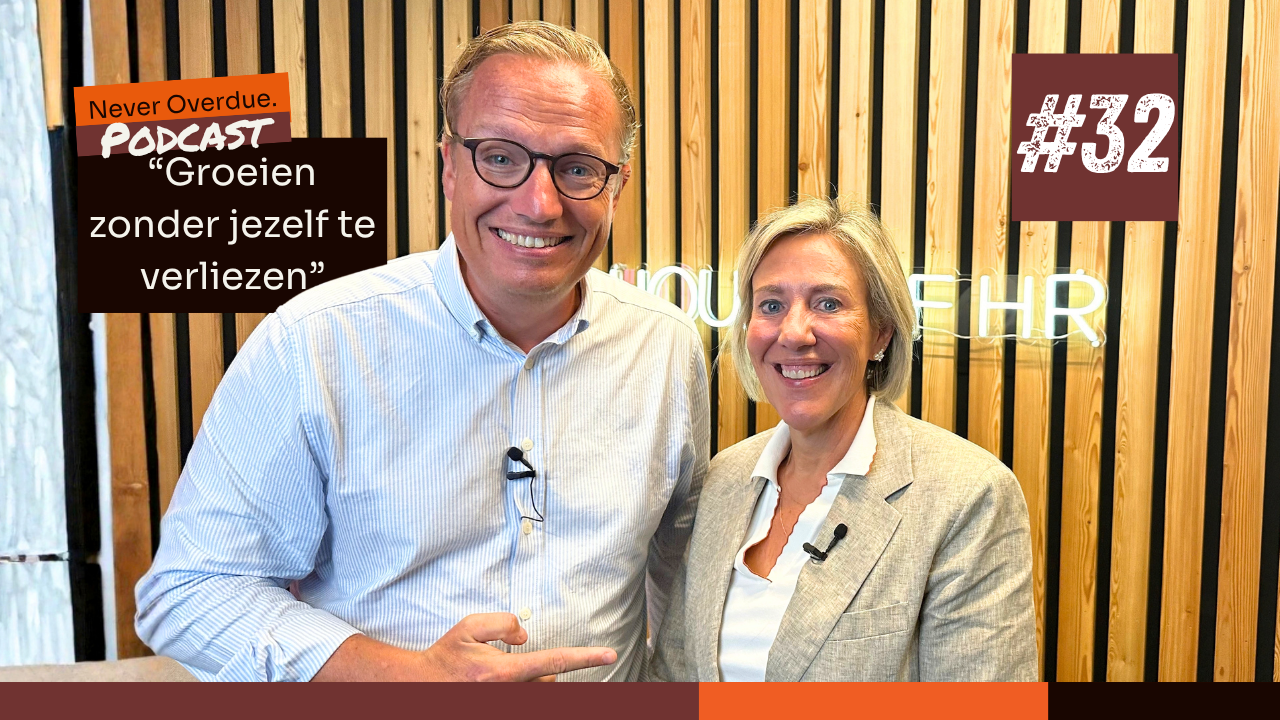
Growth sounds like a success story. More people, more clients, more revenue, more companies. But for Conny Vandendriessche, entrepreneur and co-founder of House of HR, growth primarily means being willing to look at your business anew.
In this episode of the Never Overdue Podcast, we discuss entrepreneurship, growth, labor market shortages, loyalty, cash flow, AI, and leadership. These are themes that may seem unrelated at first glance, but in practice, they constantly converge.
What does growth mean for an entrepreneur?
For Conny, growth is not simply a matter of more revenue or more employees. When a company moves to the next level, the way of working must evolve along with it.
This sometimes means you have to re-examine existing habits, structures, and choices. What worked in a smaller organization does not necessarily work when the business becomes larger and more complex.
Growth therefore requires, above all, the willingness to constantly question yourself and your organization.
When does growth become a risk?
A company can grow rapidly and yet lose control. Conny knows stories of companies that focused heavily on revenue growth but, in the meantime, paid insufficient attention to their costs.
An entrepreneur can hit a wall at a certain point. Sometimes it is then necessary to slow down and look at the foundations of the company again.
For Conny, entrepreneurship is not just about seizing opportunities, but also about the ability to adjust course in time.
Why is cash flow a reality check?
A growing business can look excellent on paper and yet struggle with a cash problem. After all, investments, personnel, and other costs often precede income.
This makes cash flow an important indicator of a company’s health. Especially during strong growth, an entrepreneur must know how much financial room there really is.
Because alongside periods where everything seems possible, there are also moments when reality can be summarized very simply: where is my cash?
Why is labor market shortage not just an HR problem?
When companies find it difficult to find people, the cause is often sought outside the organization. Conny also looks at what is happening internally.
She uses a simple comparison: a company is like a bicycle. One wheel represents the external side of the business, such as commerce and marketing. The other represents internal processes. And the cyclist is the people who move the company forward.
If one of those elements does not function well, moving forward becomes difficult.
The job itself also plays an important role. Today, people are better informed about what exists in the labor market and what their options are. A position that offers little autonomy or room for initiative therefore becomes less attractive.
Is staying long the same as being loyal?
Conny questions the classic idea of loyalty. Twenty years with the same employer does not automatically mean someone has been engaged for twenty years.
Conversely, someone can create an enormous amount of value over a shorter period and then consciously focus on a new challenge.
For her, loyalty is therefore primarily about commitment. Not about holding onto people for as long as possible, but about a situation in which people truly want to engage themselves.
What can AI take over and what can it not?
For Conny, AI goes beyond automating individual tasks. It forces companies to look at their processes again: where can technology save time, where can people be better supported, and which activities can be more efficient?
At the same time, there remains a clear boundary. AI can process information and help analyze scenarios, but it does not automatically know the context behind a business.
This became clear during an investment in Spain. Despite extensive analyses and due diligence, the future proved harder to predict than the past. Ultimately, the company was sold at a loss a few years later.
AI can therefore help to make decisions faster and be better prepared. But experience, knowledge of people, and responsibility do not disappear as a result.

What makes someone a good leader?
According to Conny, a good leader does not necessarily have to be hard. However, he or she must be clear.
Clarity about direction, expectations, and choices gives people a sense of stability. Sometimes that directness can be uncomfortable, but lack of clarity often causes more frustration.
That is why leaders must also dare to decide. Not wait endlessly until all uncertainty has disappeared, but provide direction when necessary.
Conclusion
For Conny Vandendriessche, entrepreneurship is primarily a matter of staying in motion. Not by constantly going faster, but by taking a critical look at your organization, your people, your finances, and your way of working at the right time.
Growth requires change. Technology requires responsibility. And leadership requires clarity.
Whoever wants to grow must therefore be willing to question everything again.
FAQ
Conny Vandendriessche is an entrepreneur and co-founder of House of HR, a European group of HR companies.
For Conny, growth means not only getting bigger but also daring to question the company and its way of working again.
Because growth often requires additional investments and costs. A healthy cash flow ensures that a company maintains sufficient financial room.
According to her, loyalty is less about the number of years someone stays with a company and more about engagement and the value someone creates.
AI can make processes more efficient and support people, but human experience and responsibility remain essential for important decisions.
According to Conny, good leadership starts with clarity: communicating clearly about direction, expectations, and decisions.